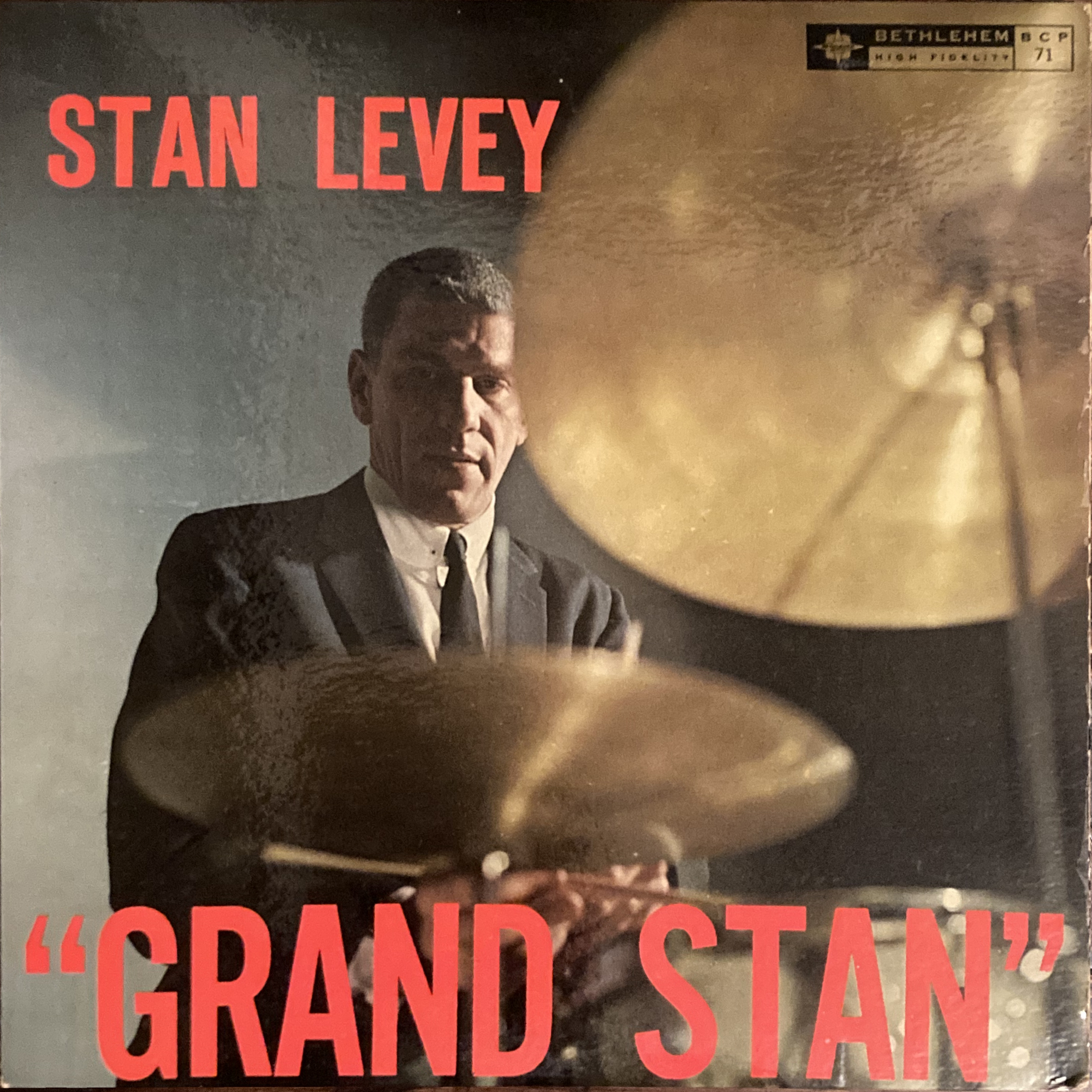
Label: BETHLEHEM
No.: BCP-71
Title: GRAND STAN
Musician: STAN LEVEY
Recorded: 1956/11
Monaural
Cover address: NEW YORK, N. Y.
Coating
Groove Guard
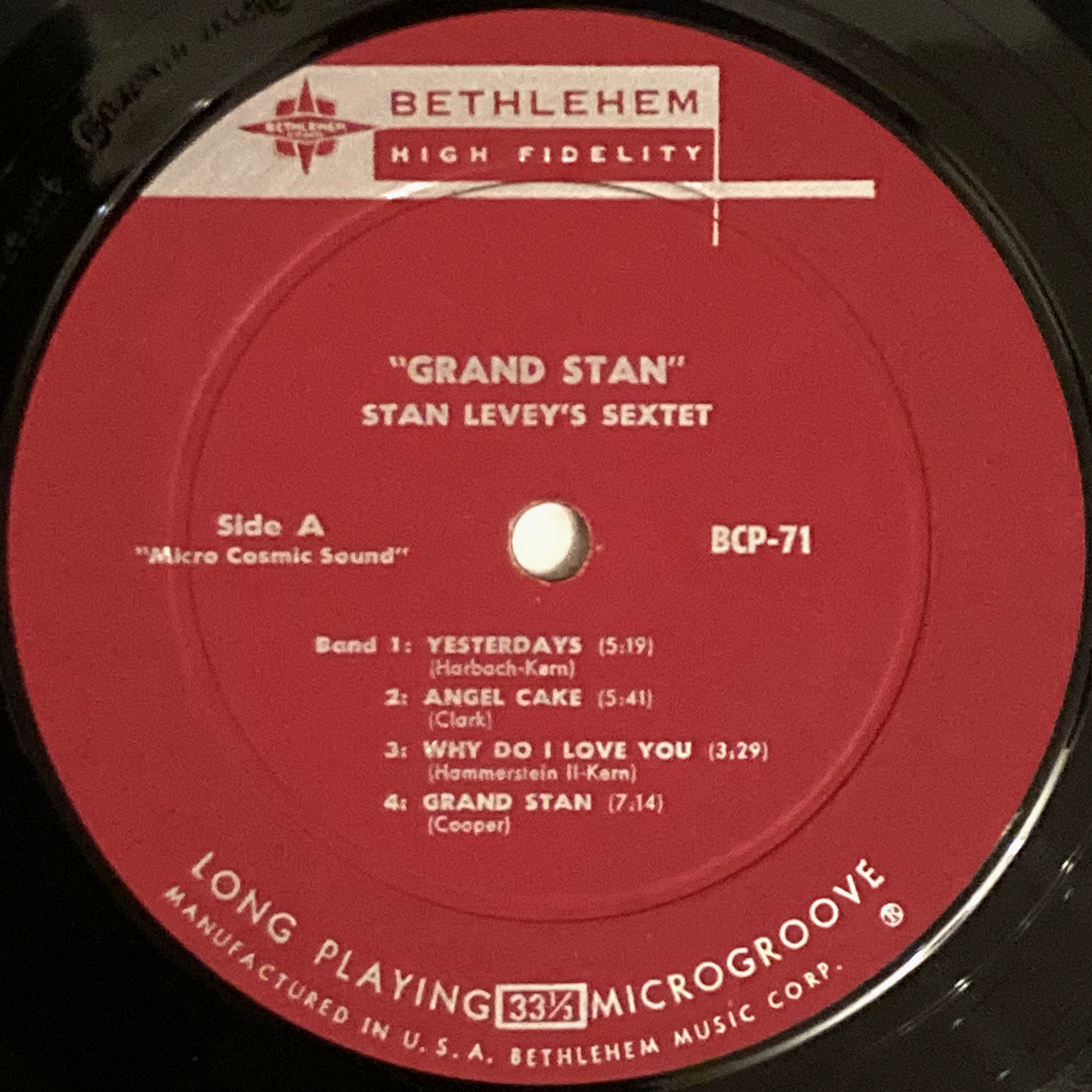
Label Side-A
Red Background
Silver Letter w/o Laurel
Address: None
Deep Groove
Dead Wax Info:BCP-71A, PAT.
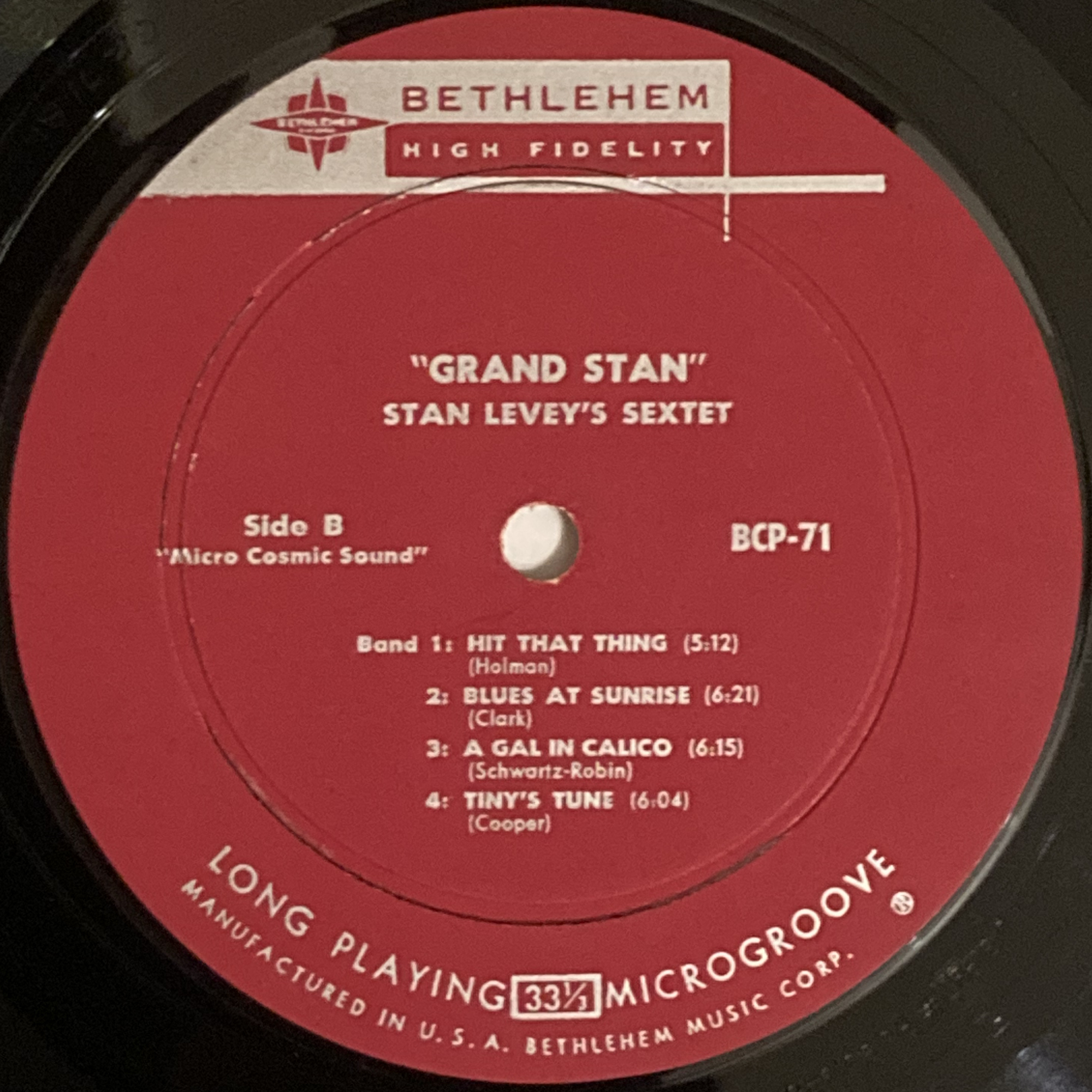
Label Side-B
Red Background
Silver Letter w/o Laurel
Address: None
Deep Groove
Dead Wax Info: BCP-71B, PAT.
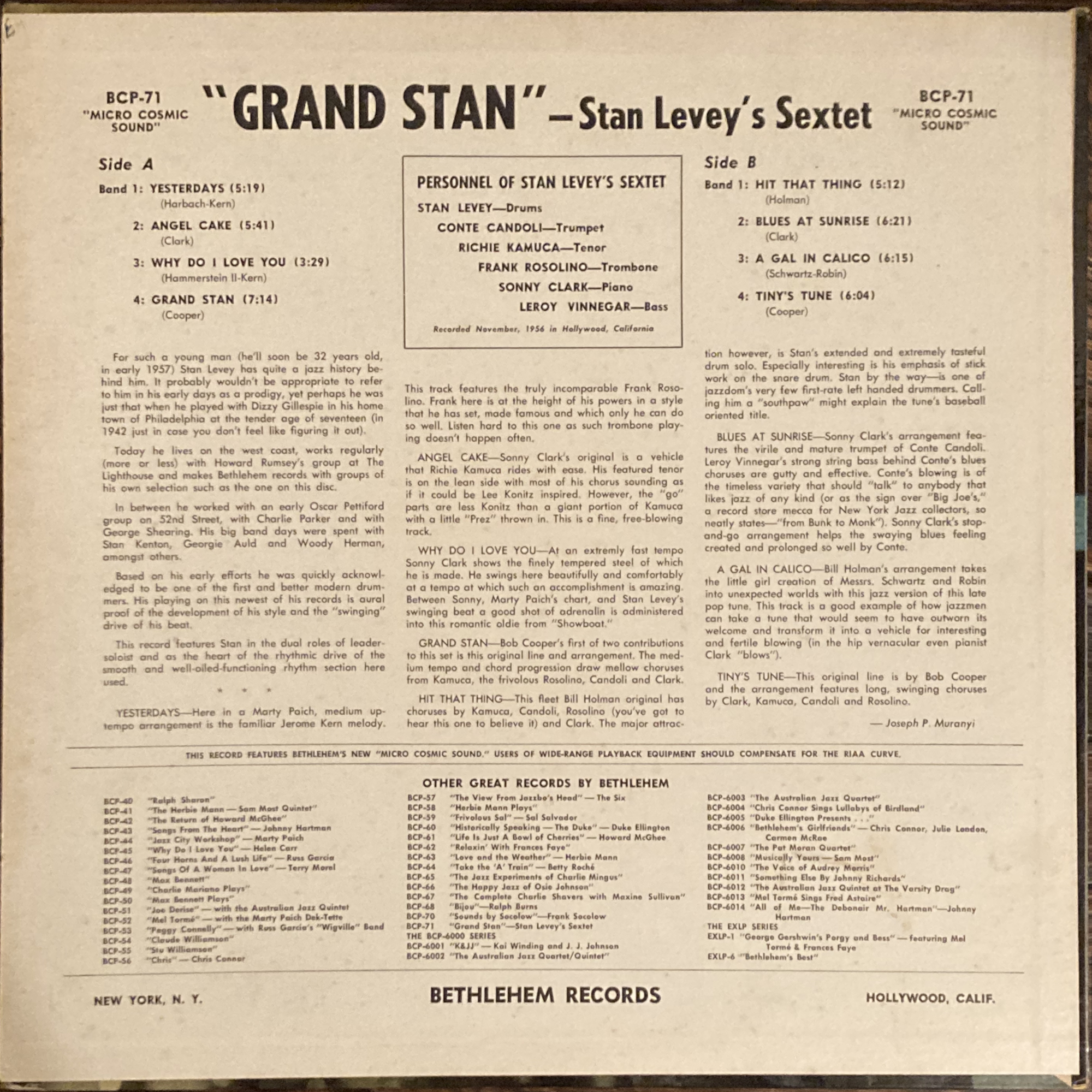
Personnel-
Drums: Stan Levey
Bass: Leroy Vinnegar
Piano: Sonny Clark
Tenor Sax: Richie Kamuca
Trumpet: Conte Candoli
Trombone: Frank Rosolino
Tracks-
Side-A
1)Yesterdays 5’19”
2) Angel Cake 5’41”
3) Why Do I Love You 3’29”
4) Grand Stan 7’14”
Side-B
1) Hit That Thing 5’12”
2) Blues at Sunrise 6’21”
3) A Gal in Calico 6’15”
4) Tiny’s Tune 6’04”
<裏ジャケ原文>
For such a young man (he’ll soon be 32 years old, in early 1957) Stan Levey has quite a jazz history be- hind him. It probably wouldn’t be appropriate to refer to him in his early days as a prodigy, yet perhaps he was just that when he played with Dizzy Gillespie in his home town of Philadelphia at the tender age of seventeen (in 1942 just in case you don’t feel like figuring it out).
Today he lives on the west coast, works regularly (more or less) with Howard Rumsey’s group at The Lighthouse and makes Bethlehem records with groups of his own selection such as the one on this disc.
In between he worked with an early Oscar Pettiford group on 52nd Street, with Charlie Parker and with George Shearing. His big band days were spent with Stan Kenton, Georgie Auld and Woody Herman, amongst others.
Based on his early efforts he was quickly acknowl- edged to be one of the first and better modern drum- mers. His playing on this newest of his records is aural proof of the development of his style and the “swinging” drive of his beat.
This record features Stan in the dual roles of leader- soloist and as the heart of the rhythmic drive of the smooth and well-oiled-functioning rhythm section here used.
YESTERDAYS-Here in a Marty Paich, medium up- tempo arrangement is the familiar Jerome Kern melody.
This track features the truly incomparable Frank Roso- lino. Frank here is at the height of his powers in a style that he has set, made famous and which only he can do so well. Listen hard to this one as such trombone play- ing doesn’t happen often.
ANGEL CAKE-Sonny Clark’s original is a vehicle that Richie Kamuca rides with ease. His featured tenor is on the lean side with most of his chorus sounding as if it could be Lee Konitz inspired. However, the “go” parts are less Konitz than a giant portion of Kamuca with a little “Prez” thrown in. This is a fine, free-blowing track.
WHY DO I LOVE YOU-At an extremly fast tempo Sonny Clark shows the finely tempered steel of which he is made. He swings here beautifully and comfortably at a tempo at which such an accomplishment is amazing. Between Sonny, Marty Paich’s chart, and Stan Levey’s swinging beat a good shot of adrenalin is administered into this romantic oldie from “Showboat.”
GRAND STAN-Bob Cooper’s first of two contributions to this set is this original line and arrangement. The med- ium tempo and chord progression draw mellow choruses from Kamuca, the frivolous Rosolino, Candoli and Clark.
HIT THAT THING-This fleet Bill Holman original has choruses by Kamuca, Candoli, Rosolino (you’ve got to hear this one to believe it) and Clark. The major attraction however, is Stan’s extended and extremely tasteful drum solo. Especially interesting is his emphasis of stick work on the snare drum. Stan by the way-is one of jazzdom’s very few first-rate left handed drummers. Call- ing him a “southpaw” might explain the tune’s baseball oriented title.
BLUES AT SUNRISE-Sonny Clark’s arrangement fea- tures the virile and mature trumpet of Conte Candoli. Leroy Vinnegar’s strong string bass behind Conte’s blues choruses are gutty and effective. Conte’s blowing is of the timeless variety that should “talk” to anybody that likes jazz of any kind (or as the sign over “Big Joe’s,” a record store mecca for New York Jazz collectors, so neatly states “from Bunk to Monk”). Sonny Clark’s stop- and-go arrangement helps the swaying blues feeling created and prolonged so well by Conte.
A GAL IN CALICO-Bill Holman’s arrangement takes the little girl creation of Messrs. Schwartz and Robin into unexpected worlds with this jazz version of this late pop tune. This track is a good example of how jazzmen can take a tune that would seem to have outworn its welcome and transform it into a vehicle for interesting and fertile blowing (in the hip vernacular even pianist Clark “blows”).
TINY’S TUNE This original line is by Bob Cooper and the arrangement features long, swinging choruses by Clark, Kamuca, Candoli and Rosolino.
-Joseph P. Muranyi
<裏ジャケ和訳>
スタン・リーヴィーはまだ若い(1957年初頭の時点で、まもなく32歳になる)にもかかわらず、すでにかなりのジャズ・キャリアを積み重ねてきた。彼を「神童」と呼ぶのは適切ではないかもしれないが、17歳という若さで故郷フィラデルフィアにてディジー・ガレスピーと共演したことを考えれば(ちなみに1942年のことだ)、やはり神童と呼ぶにふさわしかったのかもしれない。
現在は西海岸を拠点とし、ハワード・ラムジー率いるグループの一員として「ザ・ライトハウス」で定期的に演奏活動を行っているほか、本作のように自らメンバーを厳選したグループを率いて、ベスレヘム・レコードでレコーディングも行っている。
これまでの経歴を振り返ると、52丁目でオスカー・ペティフォードの初期グループに参加したほか、チャーリー・パーカーやジョージ・シアリングとも共演している。ビッグバンド時代には、スタン・ケントン、ジョージー・オールド、ウディ・ハーマンらの楽団に在籍した。
キャリア初期の活動から、彼はモダン・ジャズ・ドラマーの先駆けであり、かつ優れた奏者の一人として早くから認められていた。本作における彼のプレイは、自身のスタイルがどのように発展してきたか、そして彼のビートがいかに「スウィンギー」な推進力を備えているかを如実に物語っている。
本作でスタンは、リーダー兼ソリストという役割に加え、非常にスムーズかつ機能的に噛み合ったリズム・セクションの心臓部として、楽曲の推進力を支える役割も担っている。
「イエスタデイズ(Yesterdays)」――ジェローム・カーンによるお馴染みのメロディを、マーティ・ペイチがミディアム・アップ・テンポでアレンジしている。
このトラックでは、唯一無二の存在であるフランク・ロソリーノが聴ける。フランクはまさに絶頂期にあり、彼自身が確立し、世に知らしめた、彼にしか成し得ないスタイルを存分に披露している。これほど素晴らしいトロンボーン・プレイは滅多に聴けるものではないので、ぜひじっくりと耳を傾けてほしい。
「エンジェル・ケーキ(Angel Cake)」――ソニー・クラークのオリジナル曲。リッチー・カムカが軽やかにテナー・サックスを吹きこなしている。彼のテナーは無駄を削ぎ落としたスリムな響きが特徴で、コーラスの随所にリー・コニッツからの影響が感じられる。しかし、ここで聴かれる演奏は、コニッツというよりは、むしろカミュカの個性が色濃く出ており、そこに「プレズ(レスター・ヤング)」のニュアンスが少々加わっているといった趣だ。実に素晴らしく、伸び伸びとした演奏が展開されている。
WHY DO I LOVE YOU ― 超高速テンポの中で、ソニー・クラークは自身の強靭な音楽的資質を遺憾なく発揮している。これほど速いテンポでありながら、見事なまでに美しく、心地よくスウィングしているのは驚異的だ。ソニーのピアノ、マーティ・ペイチによる編曲、そしてスタン・リーヴィーのスウィング感あふれるビートが相まって、ミュージカル『ショウボート』の名曲であるこのロマンチックなスタンダード・ナンバーに、強烈なアドレナリンを注入している。
GRAND STAN ― 本作に2曲を提供しているボブ・クーパーによるオリジナル曲であり、編曲も彼が手掛けている。ミディアム・テンポとコード進行に乗せて、カミュカ、遊び心あふれるロソリーノ、カンドリ、そしてクラークが、それぞれメロウなソロを披露している。
HIT THAT THING ― ビル・ホルマンによる軽快なオリジナル曲。カミュカ、カンドリ、ロソリーノ(必聴!)、そしてクラークがソロをとっている。しかし、この曲の最大の聴きどころは、スタンによる長尺かつ極めてセンスの良いドラム・ソロだろう。特に、スネア・ドラムでのスティック・ワークを強調したプレイは非常に興味深い。ちなみにスタンは、ジャズ界でも数少ない、一流のサウスポー(左利き)・ドラマーの一人である。曲名の「HIT THAT THING」が野球を連想させるのは、彼がサウスポーであることと関係があるのかもしれない。
BLUES AT SUNRISE ― ソニー・クラークが編曲を手掛けたこの曲では、コンテ・カンドリによる、力強く成熟したトランペットがフィーチャーされている。コンテがブルースのソロを吹く背後で、リロイ・ヴィネガーが奏でる力強いストリング・ベースが、骨太で効果的な響きを生み出している。コンテの演奏は時代を超越した普遍的な魅力を備えており、ジャズを愛するすべての人に語りかけてくるはずだ(ニューヨークのジャズ・コレクターの聖地であるレコード店「ビッグ・ジョーズ」の看板に掲げられた「バンク(・ジョンソン)からモンクまで」という言葉が、まさにそれを端的に表している)。ソニー・クラークによる「ストップ・アンド・ゴー」を取り入れた編曲が、コンテによって見事に作り出され、持続されているブルースの揺らぎを、より一層際立たせている。 「A Gal in Calico」――ビル・ホルマンによるこのジャズ・アレンジは、シュワルツとロビンが世に送り出したあの愛らしい楽曲を、思いがけない世界へと連れ出してくれる。本作は、一見すると「もう聴き飽きた」と思われがちな曲であっても、ジャズ・ミュージシャンの手にかかれば、興味深く創造的な即興演奏(ジャズの専門用語で言えば、ピアニストのクラークでさえ「ブロー/吹く」と表現される)の格好の素材へと生まれ変わることを示す好例だ。
「Tiny’s Tune」――ボブ・クーパーによるオリジナル曲。このアレンジでは、クラーク、カムカ、カンドリ、そしてロソリーノによる、スウィング感あふれる長尺のソロ・パートが聴きどころとなっている。
――ジョセフ・P・ムラニ
※訳文の制作にはGoogleドライブとGoogle翻訳のお世話になりました。
コメント